CVE-2026-19949: Hive Blocks the All-in-One WP Migration SQLi by Default
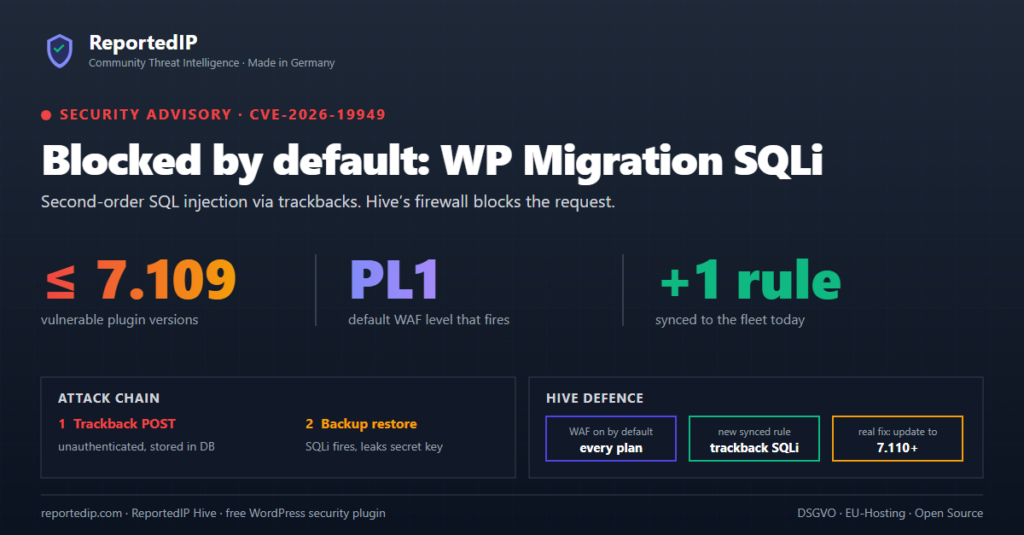
ReportedIP Hive blocks exploitation attempts against CVE-2026-19949 by default: the firewall ships enabled on every plan including Free and inspects the trackback requests this attack rides in on. The vulnerability is an unauthenticated second-order SQL injection in All-in-One WP Migration and Backup up to version 7.109, fixed in 7.110.
If you run the plugin, update to All-in-One WP Migration 7.110 or newer now. The firewall buys you time; the update closes the hole.
How the CVE-2026-19949 attack works
- The attacker sends a crafted trackback to the site, no login required. WordPress stores the payload, laced with backslash and quote sequences, as an ordinary comment.
- Nothing happens yet. The injection sits dormant in the database, which is why scanners that only watch for immediate errors miss it.
- When an administrator later restores a backup, All-in-One WP Migration mishandles the stored data and the SQL injection executes.
- The injected SQL can read
ai1wm_secret_key(the token that guards the plugin’s import endpoint) and expose it, opening the door to a full site takeover.
Security researcher Jack Taylor reported the flaw through the Wordfence bug bounty programme on August 14, 2026; ServMask shipped the 7.110 patch on August 20, and the advisory went public on September 1. Our sister company has published a German-language breakdown: CVE-2026-19949 at CMS ADMINS.
What Hive blocks out of the box
The Hive Web Application Firewall is enabled by default on every plan, runs in blocking mode (not report-only), and hooks the request pipeline at init priority 1, before WordPress processes a trackback. It inspects the URI, the full POST body and the user-agent of every request, wp-trackback.php included. Sites running the Extended Protection drop-in inspect the request before WordPress even boots.
At the default paranoia level 1, two SQL-injection signatures (waf_sqli_union and waf_sqli_bool) stop the classic payload shapes: UNION-based extraction and boolean logic with comment terminators. Both fire on every plan, including Local Shield installs that never talk to our servers.
A targeted trackback rule, synced today
Second-order injections can be built without the keywords the generic signatures look for. So on September 3 we pushed waf_sqli_trackback_2nd to the synced ruleset. It is scoped to the trackback endpoints (wp-trackback.php and /trackback/ permalinks) and flags both SELECT … FROM fragments and the backslash-quote escape primitive this attack class depends on. Legitimate trackbacks carry neither, so the false-positive surface is close to zero.
The rule is live as free ruleset v6 and professional ruleset v7, Ed25519-signed like every ruleset we publish. Community Network sites pick it up on their next rule sync; Local Shield installs receive it bundled with the next plugin release. One honest limitation: the second stage of this attack, the restore, runs inside PHP with no HTTP request involved, so no firewall can see it. Blocking the ingress vector is containment; the update to 7.110 is the fix.
Harden your site in five minutes
- Get ReportedIP Hive: 18 attack sensors, the WAF and four 2FA methods, free on every plan
- Read the plugin documentation: WAF modes, rule sync and exception handling
- See all 18 sensors in detail: what each one catches and its default threshold